
· by Michael Blair, Nashville's Painters
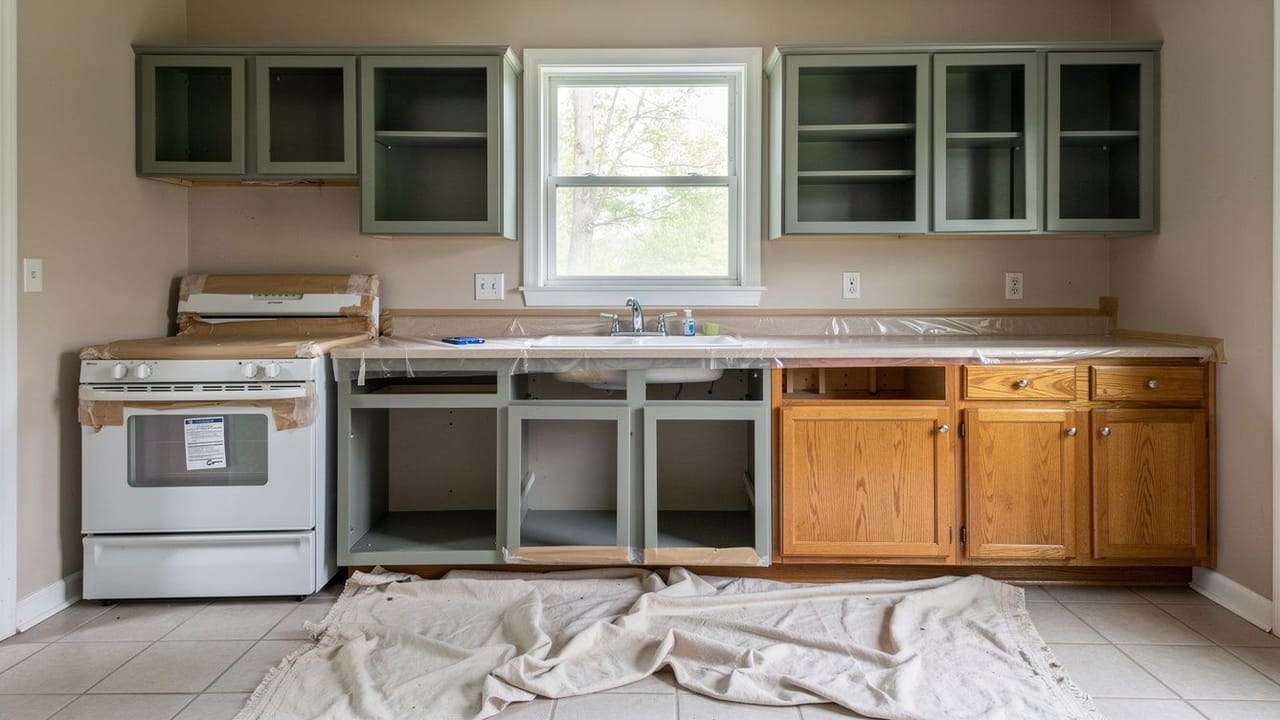
Painting cabinets keeps the boxes, the doors and the layout you already paid for and puts a new finish over them. It also fails visibly when the preparation is rushed, because cabinet doors get touched, wiped and knocked far more often than the walls around them. This post is about whether to paint at all. If you already know you will, start with our cabinet painting service, and our step-by-step post on painting kitchen cabinets walks through the order the work goes in.
Which kitchens are good candidates for cabinet painting?
Solid boxes in good order, doors that are not delaminating, and a layout you are happy to keep. The finish is what you are changing; the geometry stays.
Thermofoil doors whose film is peeling are not candidates, and neither are particleboard boxes that have swollen from a leak at the sink base. Paint does not fix substrate failure. Sound thermofoil is another matter: Benjamin Moore’s technical data sheet for Advance satin lists an all-purpose primer for MDF, thermofoil and laminate, and it says any peeling or scaling coating has to come off before painting. Where a sink base has swollen, we suggest having that box rebuilt or replaced before we price any paint.
Where the work actually is
Degreasing. Kitchen cabinets carry a film of cooking grease and hand oil, heaviest around the range and under the vent hood, and much of it cannot be seen. The Advance sheet says a surface has to be clean, dry and free of grease and oil before it is painted, and enamel laid over that film will not bond well. It is also the easiest step to cut short, because a door can look clean and still be greasy.
Then scuff sanding every surface, then a primer matched to the existing finish. For cabinetry, Benjamin Moore calls for roughening every surface with 220 grit or coarser before priming and says glossy areas should be dulled. Factory finishes are hard and slick, which is why we sand them rather than trusting primer alone. The same sheet names an all-purpose primer for wood and engineered wood, so the choice depends on what the doors are made of and what is on them now, which our post on when primer is actually necessary goes into.
Old paint adds one more question in an older house. The EPA’s Renovation, Repair and Painting program requires anyone paid to disturb paint in housing built before 1978 to be certified in lead-safe work practices, sole proprietors included, although the rule generally does not apply to homeowners working on their own home. The EPA’s Steps to Lead Safe Renovation, Repair and Painting pamphlet sets out how that kind of job is planned and cleaned up, and our post on lead paint in older Nashville homes covers what it means when painted cabinets in a pre-1978 kitchen are sanded.
- Degrease every surface, and go over the range side a second time
- Remove doors, drawers and all hardware
- Scuff sand every surface to be coated
- A primer matched to the material and the existing finish
- Two finish coats, sanded lightly between
Product matters more here than anywhere
We do not put wall paint on cabinets. What goes on is an enamel made for cabinets and trim. Benjamin Moore describes Advance as a waterborne alkyd enamel with a tough finish that stands up to repeated washing, and lists cabinets, trim and doors among its uses, while Sherwin-Williams describes its Emerald Urethane Trim Enamel as a waterbased urethane modified alkyd suited to surfaces that get cleaned often. The Advance sheet explains why the wait matters: the paint dries by evaporation and cures by oxidation, and its full hardness and adhesion arrive over time.
Cure time is not dry time. At 77 °F and 50 percent humidity, the satin Advance sheet puts it dry to the touch in 1 to 2 hours and ready to recoat in 4, yet it asks for at least 5 to 7 days before heavy abrasion and allows up to 30 days for the paint to reach optimum hardness and final sheen. High humidity and cooler temperatures stretch every one of those times, and the sheet keeps the surface between 50 °F and 90 °F while painting, which is worth planning around in a muggy Nashville August or an unheated garage in January. Treating the doors gently through that stretch is what preserves the finish.
For anyone choosing a bright white, the same sheet notes that Advance yellows less than conventional alkyds but can still yellow slightly, faster in dark or poorly ventilated spots and more visibly in light colors.
Is it better to spray or brush cabinets?
In our experience, sprayed doors give the smooth, even finish people are actually picturing when they think of painted cabinets. Brush and roller work tends to leave texture that reads as painted, however carefully it is done. The Advance sheet gives settings for brush, roller, airless spray and HVLP, so the product allows any of them; the difference shows in the result.
That is why we take the doors and drawer fronts off to spray them and paint the boxes in place. A quote that involves brushing everything on its hinges is a different product at a different price, and it should be priced as one. When you ask us for a free estimate, the written quote says which parts get sprayed and which get brushed.
Sources
- Benjamin Moore, Advance Waterborne Alkyd Interior/Exterior Satin W792, Technical Data Sheet — Clean and grease-free surfaces; peeling coatings removed; cabinetry sanded with 220 grit or coarser before priming and glossy areas dulled; primer for wood, MDF, thermofoil and laminate; 1 to 2 coats; dry, recoat, 5 to 7 days before heavy abrasion and up to 30 days to optimum hardness; 50 F to 90 F; slight yellowing; brush, roller and spray settings
- Sherwin-Williams, Emerald Urethane Trim Enamel product page — Interior/exterior waterbased urethane modified alkyd for surfaces cleaned frequently
- US EPA, Renovation, Repair and Painting Program — Paid work disturbing paint in pre-1978 housing requires lead-safe certification, sole proprietors included; homeowners working on their own home generally exempt
- US EPA, Steps to Lead Safe Renovation, Repair and Painting — Pamphlet on planning and completing painting work in pre-1978 housing with lead-safe work practices
FAQ
Painting Kitchen Cabinets Instead of Replacing — questions
How long do painted cabinets last?
We have not found a paint maker that publishes a service life for painted cabinets, so we do not promise a number of years. What decides it is the preparation and the first few weeks: clean, sanded, primed doors in a cabinet enamel that is allowed to cure before hard use wear far better than a rushed job. Poorly prepared work shows itself first as chipping at the door edges and around the handles, which is where to look on any painted kitchen you are shown as an example.
Can oak cabinets be painted?
Yes, though the open grain shows through the paint as texture unless it is filled first. If you want a smooth modern look, we fill the grain, and that adds real labor; if you are content with visible grain texture, we skip that step. Decide which you want before getting quotes, because it materially changes the price.
Is painting cabinets cheaper than replacing?
Usually, because you keep the boxes, the doors and the layout, and what you pay for is preparation and finish rather than new cabinetry and its installation. How much less depends on the number of doors and drawer fronts and their condition, so we give a price for your kitchen rather than a rule of thumb. The comparison changes if you also want a different configuration, soft-close hardware and new drawer boxes, at which point you are approaching a partial replacement anyway.
Can you paint cabinets with regular paint?
We would not. Cabinet doors are touched, wiped and knocked far more than walls, so we use an enamel made for cabinets and trim, such as Benjamin Moore Advance or Sherwin-Williams Emerald Urethane Trim Enamel, and give it time to cure before hard use.