
· by Michael Blair, Nashville's Painters
Ask around for kitchen cabinet painting in Murfreesboro and the quotes can look like they describe different jobs, because often they do. One painter brushes the doors while they hang on their hinges; another takes every door and drawer front away, sprays them flat, and hands the kitchen back days later. Both call it cabinet painting. If you are still weighing paint against new cabinets, start with painting kitchen cabinets instead of replacing. This post picks up after that decision: the order the work goes in, what each step is for, and what moves the price, which is also how our crews run every job on our cabinet painting page.
Taking the kitchen apart comes first
The first day of a cabinet job that lasts involves very little paint. Doors come off their hinges, drawer fronts come off or the drawers come out, and every pull, knob and hinge goes into a bag. Each door gets a number on a tape tab in a spot the hinge will cover, and the same number goes inside the opening it came from. Hinges are adjusted to one opening, and a door rehung on the wrong box sits crooked and rubs its neighbor.
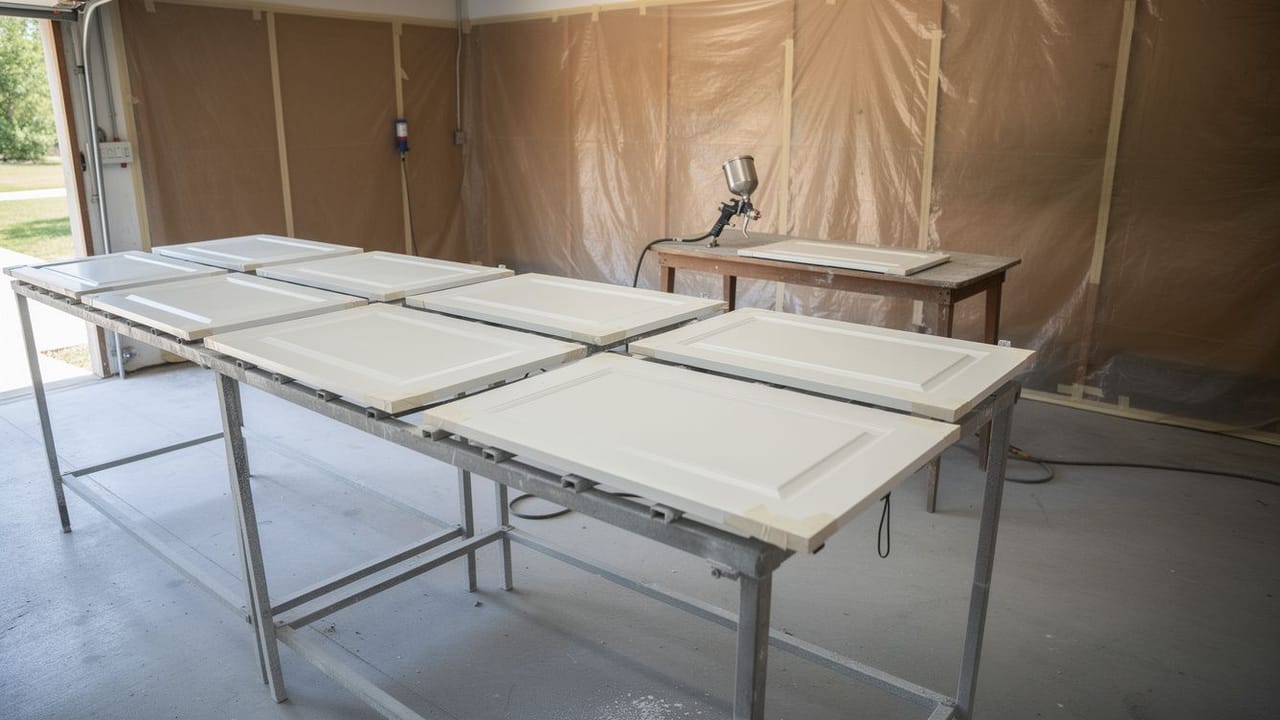
The takedown is what makes a sprayed finish possible. A door lying flat on a rack can be coated on the back, the edges and the face in even passes, with no outline left around a hinge or a knob. The boxes and face frames stay in the kitchen and get painted in place, so countertops, walls, appliances and the floor are masked and covered first. That masking takes longer than most people expect, and a quote that leaves the doors on the wall is skipping it along with the spray.
Getting the old finish ready to hold paint
Cabinets carry a film of cooking grease and hand oil, heaviest beside the range and around the pulls, and paint will not bond to it. Benjamin Moore’s Cabinet Coat technical data sheet calls for removing grease with an emulsifier and adds the instruction that decides more cabinet jobs than any other: clean before you sand, so the sanding does not drive the contamination into the surface. The company’s guide to painting kitchen cabinets follows the same order, a mild degreaser, a full dry, then a scuff with 100 to 150 grit.
Many Murfreesboro kitchens went in with the subdivisions built from the 2000s on, and builder cabinets usually wear a hard, slick factory finish. Sanding gives primer something to grip. The Advance technical data sheet wants every cabinet surface roughened with 220 grit or coarser before priming, and light sanding between coats after that. Where a profile is too detailed to sand evenly, a deglosser does the job chemically; the Cabinet Coat sheet says glossy surfaces and melamine should be properly deglossed.
The primer is picked for what the door is made of. On cabinets the answer to whether primer is necessary is nearly always yes, and the real question is which one. Benjamin Moore’s guide also warns against a lacquer-based primer under its acrylic system. Here is how the two Benjamin Moore data sheets match material to primer:
- Wood, MDF and thermofoil: sand, then one coat of Advance Primer
- Laminate: a high-hiding all-purpose primer instead
- Vinyl veneer: sand the veneer away with 100 grit, then prime
- Melamine under Cabinet Coat: degloss and lightly sand, no primer
Sprayed enamel, and three different clocks
Cabinet enamel is not wall paint. Cabinet Coat is a urethane-reinforced waterborne acrylic, Advance is a waterborne alkyd, and Sherwin-Williams’ Emerald Urethane Trim Enamel product data sheet describes a waterbased urethane-modified alkyd. Each can go on by brush or roller, and each data sheet lists airless or HVLP spray settings. Spraying lays down a level film without brush marks, which matters with a fast product; the Cabinet Coat sheet notes that it dries quickly and that overworking it leaves marks. The doors get two finish coats over the primer, sanded lightly between.
Time is the part people misjudge. Each data sheet gives a dry time and a recoat time at 77 F and 50 percent relative humidity. Advance is dry to the touch in 4 to 6 hours and ready to recoat in 16. Cabinet Coat is tack free in an hour and recoatable in 6. Emerald Urethane is touch dry in an hour and recoatable in 4, depending on film thickness. Dry to the touch means dust will not stick to it, and not much more.
Cure is the third clock, and it decides how the finish wears. The Cabinet Coat sheet gives full cure as 14 days. The Advance sheet says to keep surfaces out of service for at least 3 to 5 days and allows up to 30 days for full hardness and final sheen. Sherwin-Williams does not publish a full-cure time for Emerald Urethane. Both Benjamin Moore sheets limit application to between 50 F and 90 F, and the Advance sheet says humidity and cool temperatures lengthen every one of these times, so a muggy Middle Tennessee week slows the whole schedule.
Why two cabinet quotes rarely match
A cabinet price is built from the piece count, not the size of the kitchen. Every door and drawer front is handled again and again: removed, cleaned, sanded, primed, sanded, coated twice, racked and rehung. A kitchen with a long bank of narrow drawers can have more pieces than a bigger kitchen with wide doors, and raised-panel doors with deep profiles take longer to sand and spray evenly than flat slab doors. Painting the insides of the boxes and the backs of the doors changes the count again.
Condition is the second variable. Grease baked on beside the range takes more than one cleaning. Chips, dents and loose edge banding need filling or regluing before primer. Open-grain oak shows its grain through paint unless it is filled, which is a step of its own. Thermofoil needs a candid look before anyone prices it: the film has to be firmly bonded, any of it that has lifted has to come off, and the system the manufacturer lists calls for sanding and a bonding primer, not a quick scuff and a coat of enamel. A swollen sink base is a carpentry repair before it is anything else.
A quote that leaves out the takedown, the degreasing, the primer matched to the surface or the cure time will come in lower and still read like the same job on paper. When we quote a kitchen in Murfreesboro and the rest of Rutherford County, we count the doors and drawer fronts, look at the existing finish and the state of each piece, and write down which steps are included. To have us look at yours in person, ask for a free estimate.
Sources
- Benjamin Moore, Advance Waterborne Interior Alkyd Semi-Gloss 793, Technical Data Sheet — Dry, recoat and return-to-service times, up to 30 days to full hardness, sanding before priming, primer by substrate including thermofoil, laminate and vinyl veneer, 50 F to 90 F application
- Benjamin Moore, How to Paint Kitchen Cabinets — Degrease, scuff with 100 to 150 grit, acrylic primer and no lacquer-based primer, two coats, time before rehanging doors and before heavy cleaning
- Benjamin Moore (INSL-X), Cabinet Coat Satin CC-55XX, Technical Data Sheet — Tack free, recoat and 14-day full cure, clean before sanding, deglossing glossy surfaces and melamine, overworking leaves marks
- Sherwin-Williams, Emerald Urethane Trim Enamel, Product Data Sheet — Waterbased urethane-modified alkyd, touch and recoat times dependent on film thickness, spray settings