
· by Michael Blair, Nashville's Painters
Most backyard fences around Nashville are pressure-treated pine pickets on treated posts, and sooner or later every owner asks the same thing: stain it or paint it? The answer turns less on color than on how the wood behaves. A fence stands in the weather on both faces, the boards are usually rough-sawn, and the bottom edges stay damp after every rain. Those conditions favor one kind of finish over the other, and they also decide when new boards can take anything at all. This is how our crews think it through on the fence jobs we take under deck and fence staining, drawing on the federal research that still sets the standard for finishing exterior wood.
Two kinds of finish, and why a fence cares
Exterior wood finishes split into two families. Paint and solid-color stain form a film on the surface. Penetrating stains soak into the wood and leave little or no film behind. The USDA Forest Products Laboratory’s FinishLine on choosing a finish describes paint as the better shield against liquid water and sunlight, but only on smooth, stable surfaces. It names fences directly among the places penetrating stains suit, along with siding, trim, exposed decking and shingles, and says those stains work best on rough-sawn, weathered or coarse wood.
That is a fair description of a privacy fence. The pickets are rough, they swell and shrink with the weather, and water gets at them from both faces and from the ground up. A film holds up only as long as the wood under it stays put and stays dry. Purdue Extension’s older but still sound bulletin on exterior wood finishes puts the weakness plainly: a paint film can blister or peel when the wood behind it gets wet, and a penetrating stain does not. On a fence, the wood gets wet all the time.
The same failure shows up on painted wood all over a house, which is why our post on why exterior paint fails early spends so much time on moisture. A fence just has fewer places for that moisture to go.
What each finish asks of you afterward
Paint does last longer between coats when it holds. The Forest Products Laboratory gives a life-span range for each type of finish, and the spread is wide:
- Water repellents: 6 to 12 months
- Clear water-repellent preservatives: 1 to 2 years
- Pigmented water-repellent preservatives: 2 to 3 years
- Semitransparent stains: 3 to 8 years
- Solid-color stains: 3 to 7 years
- Paint: 7 years or more
Stain, solid stain or paint on your fence
The numbers in that list leave out what happens at the end of each finish’s life. The same FinishLine notes that refinishing extends the life of repellents, preservatives and semitransparent stains, and that a penetrating stain can go back on weathered wood without the surface prep paint demands. When a semitransparent stain wears thin, the fence gets cleaned and recoated. When paint wears out on a fence, it tends to peel, and peeling paint has to be scraped off board by board before anything new will stick. On a few hundred feet of pickets, that difference is most of the cost of the next round.
Within the stain family, the base matters. The FPL guide says an oil-based semitransparent stain lets the wood breathe, so it will not blister or peel even when moisture in the wood runs high. It also says latex semitransparent stains form a film and do not behave like true penetrating stains. So a can that says semitransparent is not enough to go on; it is the oil base that gives the fence the forgiving behavior.
Solid-color stain looks like paint and acts more like paint, film and all. It is the choice when someone wants a fence to match the trim color or hide mismatched boards, with the understanding that it will eventually need prep work closer to what paint needs. Paint itself can work on a fence that is smooth, sound and dry. Done properly, the FPL calls for a primer and two coats of acrylic latex, with a brush doing better than other methods, especially on the first coat, and for latex it wants temperatures above 50 F for 24 hours after application, or above 40 F for oil. On a long fence line that is a lot of brushing, which is part of why we steer most fence owners toward a penetrating stain and keep paint for the fences that really suit it, often the same short runs we look at alongside an exterior painting job on the house.
New pressure-treated boards, and the gray fence
New treated lumber arrives wet from the treatment, and finish put on too early cannot soak in. The common advice to let a new fence sit a full year before staining does more harm than good. The FPL guide says modern treated wood should be finished as soon as it is dry, which it puts at a few weeks after construction, and refinished about two years later after a gentle cleaning. Leaving it to weather a year does open the pores, but the guide notes that the weathering damages the wood surface while it does so.
Viance, which develops wood preservatives, gives a longer typical wait in its advice on staining decks and fences: ready for finish about 60 days after installation, depending on how long ago the wood was treated, how much sun the boards get, the temperature and recent weather. The two numbers differ, and a wet Middle Tennessee spring can stretch either one, so we go by the wood rather than the calendar. Viance’s test is simple: sprinkle water on the boards, and if it soaks in readily, the wood will take stain, paint or sealer. If it beads and sits there, the fence needs more time. Its deck finishing FAQ also notes that most makers of water-repellent coatings call for a fresh coat every year, so follow the label on whatever goes on.
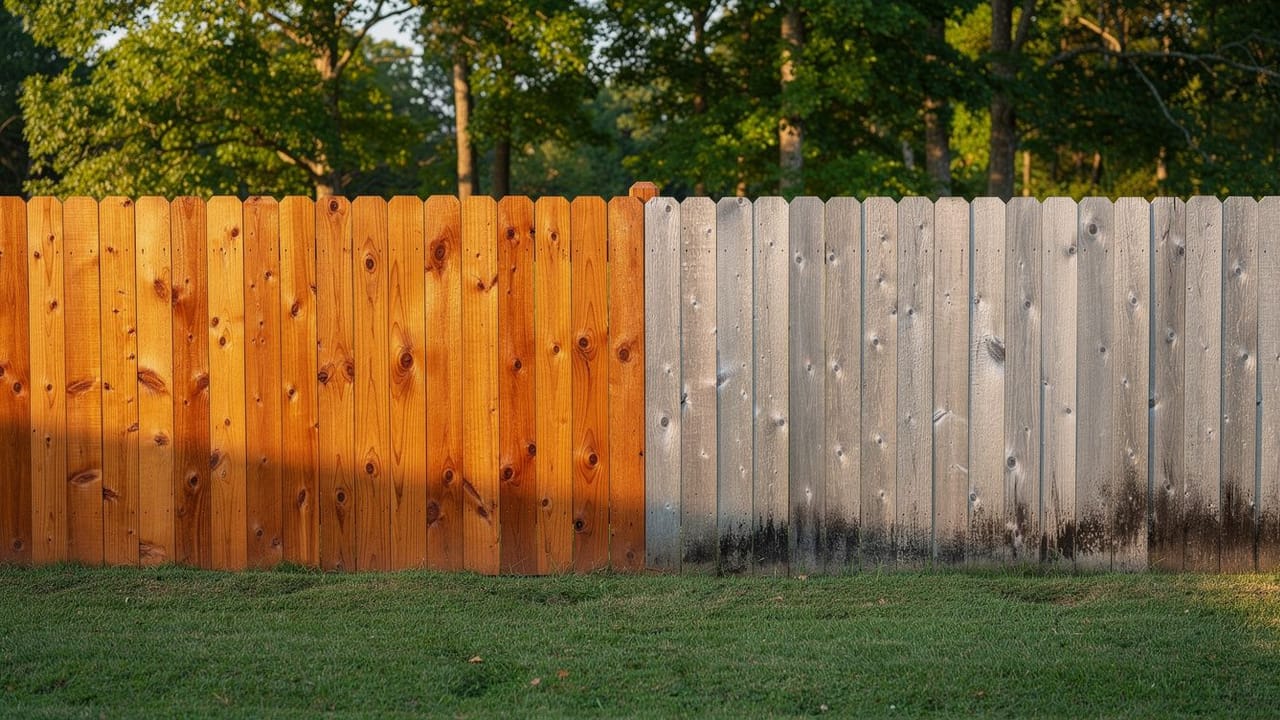
Older fences bring the opposite problem. The silver-gray look on an unfinished fence here is mostly mildew, according to the FPL, and in our humid summers it spreads fast on shaded runs and near the ground. The guide calls for cleaning a dirty or mildewed fence with bleach and detergent before stain goes on, and it warns that aggressive washing strips away wood fibers that would otherwise have absorbed the finish. A pressure washer turned up high can leave a fence furred and patchy, and the stain will show every pass. On rough or weathered lumber, the FPL recommends two coats of penetrating stain, with any excess wiped off so it does not dry into a film on the surface.
Fence questions come up most around the newer neighborhoods in Franklin and Williamson County, where long runs of treated privacy fence went in with the houses, but the decision is the same across Middle Tennessee. If you want us to walk your fence, test the boards and tell you which finish it will hold, ask for a free estimate.
Sources
- USDA Forest Service, Forest Products Laboratory: FinishLine, Paint, Stain, Varnish, or Preservative? It’s Your Choice (Knaebe, rev. 2013) — Film-forming vs penetrating finishes, life spans by finish type, treated-wood timing, mildew and cleaning, application temperatures.
- Purdue Extension NCR-135: Selection and Application of Exterior Finishes for Wood (Cassens and Feist, 1986) — Why a paint film blisters or peels when the wood behind it is wetted, and penetrating stains do not.
- Viance (TreatedWood.com): Staining Decks and Fences — Typical 60-day drying time for new treated wood, the factors that change it, and the water test.
- Viance (TreatedWood.com): Deck Finishing FAQs — Annual reapplication of water-repellent coatings per most manufacturers.