
· by Michael Blair, Nashville's Painters
Once the walls are done, the questions turn to the smell: how long it will hang around, and when someone can sleep in the room again. There is no single clock for it. It depends on the paint, the size of the room and how much fresh air moves through it, and the best guidance available speaks in terms of ventilation rather than a moment when the air is clean again. This is how we handle the airing out at the end of an interior painting job, and what the federal guidance and one paint maker’s own sheet actually say.
How long should a freshly painted room air out?
For at least 72 hours after the paint goes on, with as much fresh air moving through the room as you can manage, is the U.S. EPA’s typical recommendation. Its guidance on indoor air quality when remodeling your home says to keep maximum ventilation going while paints, finishes and other products likely to off-gas are applied, and for at least 72 hours after the work is finished.
Read that number for what it is. It is a recommendation for how long to ventilate, not a measurement of when the odor ends or the air is back to normal, and EPA does not present it as either. Its page on volatile organic compounds and indoor air quality notes that paints and varnishes contain organic solvents, that VOC levels are often higher indoors than out, up to ten times higher by its figure, and that elevated levels can persist long after the activity is completed. A large room with a cross-breeze may stop smelling sooner than a small closed bedroom, and neither nose tells you exactly what is still in the air.
Drying is a different clock again. One manufacturer’s sheet for one product, Sherwin-Williams’ product data sheet for ProMar 200 Zero VOC Interior Latex Eg-Shel, gives 1 hour to touch and 4 hours to recoat at 77 °F and 50 percent relative humidity, and says those times depend on temperature, humidity and film thickness. Dry to the touch is a statement about the surface of the wall, not about the air in the room.
Moving the air out, not around the house
The aim is to push the air out of the painted room rather than stir it through the rest of the house. EPA recommends exhaust ventilation, such as a fan blowing out of the work area, because it pulls pollutants out and, by setting up a pressure barrier, keeps them from spreading to other rooms. The same guidance suggests covering the supply and return registers for the heating and cooling system in that room so the ducts do not carry the air through the house, and then making sure the room has its own ventilation.
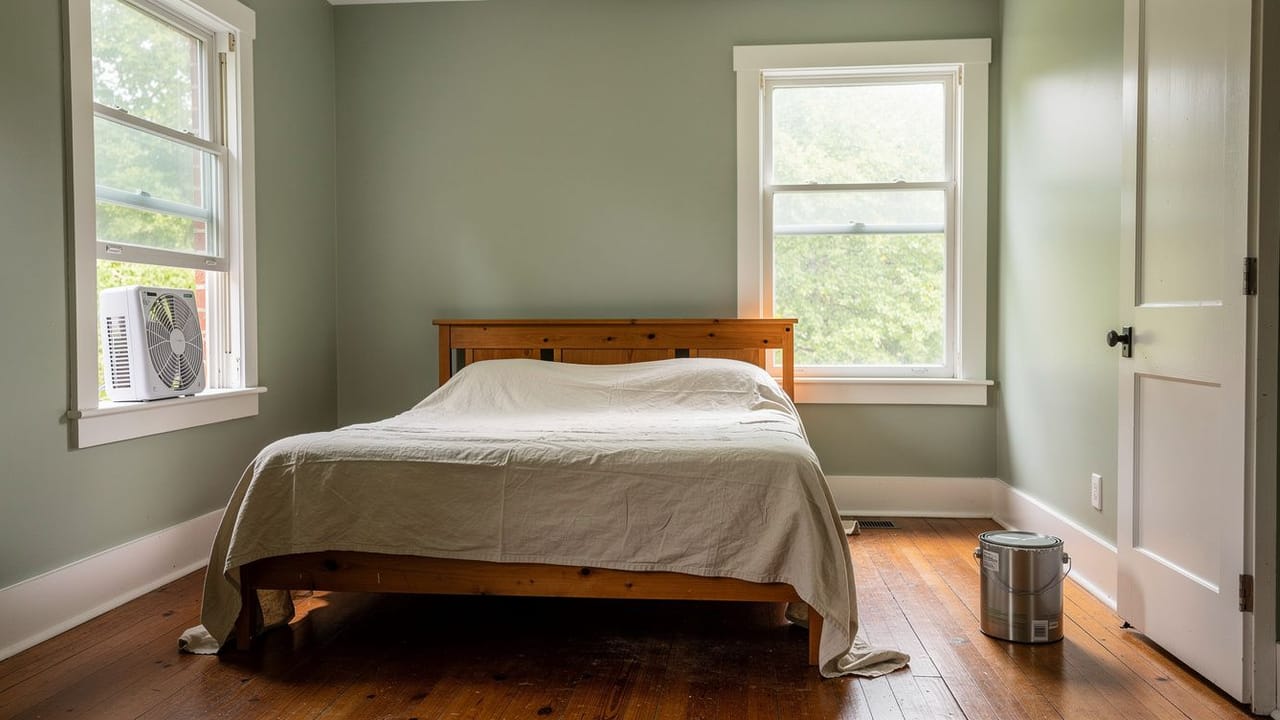
On our jobs that means a box fan in a window pointed outward, a second window open across the room where there is one, the door to the hall kept closed, and the registers covered until the room has aired out. Once the system is running normally again, the registers come back open.
Two smaller steps help. EPA asks that paint containers be sealed carefully after use and kept in a storage area, preferably one with exhaust ventilation and not near the heating and air equipment, so leftover cans go out to the garage or a shed with their lids tapped down. And where shelves, doors or trim pieces can be painted outside and brought in dry, EPA recommends doing it that way.
Does zero-VOC paint still have an odor?
It can, and the data sheet for a zero-VOC product shows why the name is not a promise of nothing in the air. The same Sherwin-Williams sheet lists the paint’s VOC content, figured by the federal method in 40 CFR 59.406, as less than 50 grams per liter, and notes beside the tinting base that the figure may vary by color.
It also still carries the ventilation caution. The label text on the sheet says to use the paint only with adequate ventilation and to open windows and doors, or otherwise bring in fresh air, while it is applied and while it dries. EPA’s VOC guidance points the same way: increase ventilation when using products that give off VOCs, and meet or exceed any precautions on the label.
So we treat a zero-VOC or low-VOC product as a reason for less concern, not a reason to skip the fan. If you are choosing a finish as well as a product, our room-by-room guide to paint sheen covers that part.
What should you do if paint fumes give you a headache?
Get more fresh air into the room or leave it, which is what the label itself tells you to do. The Sherwin-Williams sheet says that anyone who gets watering eyes, headaches or dizziness should increase fresh air, wear NIOSH-approved respiratory protection, or leave the area. EPA lists eye, nose and throat irritation, headaches and dizziness among the symptoms some people report soon after exposure to organic chemicals.
For a bedroom, our practice is simple. Whoever sleeps there sleeps somewhere else while the room is still being ventilated, and children stay out of it, since EPA advises keeping occupants, especially children, away from the work area. No source we found gives a set number of hours after which a freshly painted room is safe to sleep in, so we will not invent one. If the room still smells strongly when you open the door, it has not finished airing out.
If you are fitting the painting around a move-in date, our post on how long a paint job takes covers the schedule, and the airing out belongs at the end of it. Tell us the rooms and the date you need them back, for a house in Nashville or nearby, and we will plan the ventilation into the estimate.
Sources
- U.S. EPA, Best Practices for Indoor Air Quality when Remodeling Your Home — Maximum ventilation during the work and for at least 72 hours after; exhaust fans and covered registers; occupants, especially children, kept away; finishes applied outside where possible; paint storage
- U.S. EPA, Volatile Organic Compounds’ Impact on Indoor Air Quality — Paints contain organic solvents; indoor levels up to ten times outdoor; elevated levels persist after the activity; symptoms; ventilation and label precautions
- Sherwin-Williams, ProMar 200 Zero VOC Interior Latex Eg-Shel, Product Data Sheet — One product: touch 1 hour and recoat 4 hours at 77 °F and 50% RH; VOC less than 50 g/L per 40 CFR 59.406, may vary by color; ventilation and symptom cautions
FAQ
How Long to Air Out a Room After Painting — questions
How long do paint fumes last in a room?
There is no fixed answer. EPA’s typical recommendation is maximum ventilation during the work and for at least 72 hours after it, but that is a ventilation guideline, not a measured point when the smell ends. The paint, the size of the room, the temperature and how much air moves through it all change how long fumes linger.
Is it safe to sleep in a room you just painted?
No source we rely on gives a number of hours. EPA advises keeping occupants, especially children, away from the work area and ventilating hard for at least 72 hours afterward. We suggest sleeping elsewhere through that airing-out period where you can, and following the ventilation cautions printed on the paint label.
How long should you ventilate after painting a room?
EPA’s typical recommendation is maximum ventilation while painting and for at least 72 hours after the work is finished. In practice that means a fan in a window blowing outward, another window open if there is one, the door to the rest of the house closed and the room’s heating and cooling registers covered.
Can paint fumes make you sick?
They can cause symptoms. One paint maker’s label tells anyone who gets watering eyes, headaches or dizziness to increase fresh air, wear NIOSH-approved respiratory protection or leave the area, and EPA lists headaches and dizziness among the effects some people report after exposure to organic chemicals. Anyone who feels unwell should get into fresh air.
Does low-VOC paint still smell?
It can. Even a zero-VOC eg-shel’s data sheet lists its VOC content as under 50 grams per liter by the federal method, varying by color, and still tells users to paint only with adequate ventilation. A lower VOC figure is a reason for less worry, not a reason to skip the fan.
How do you get the paint smell out of a room faster?
Move the air out of the house rather than around it. Set a fan in a window blowing outward, open another window across the room, close the door to the hall and cover the room’s supply and return registers. Seal leftover cans and store them away from the living space and the heating equipment.