
· by Michael Blair, Nashville's Painters
The default advice is to strip wallpaper before painting, and it is usually right. Zinsser’s ShieldZ Clear Wall Size data sheet tells you to remove existing wallcovering “whenever possible.” The exceptions we meet on interior painting jobs are older Nashville houses with original plaster and rooms where paper went straight onto drywall that was never sealed. On those walls, in our experience, stripping can do more harm than the paper was doing.
When is it okay to paint over wallpaper?
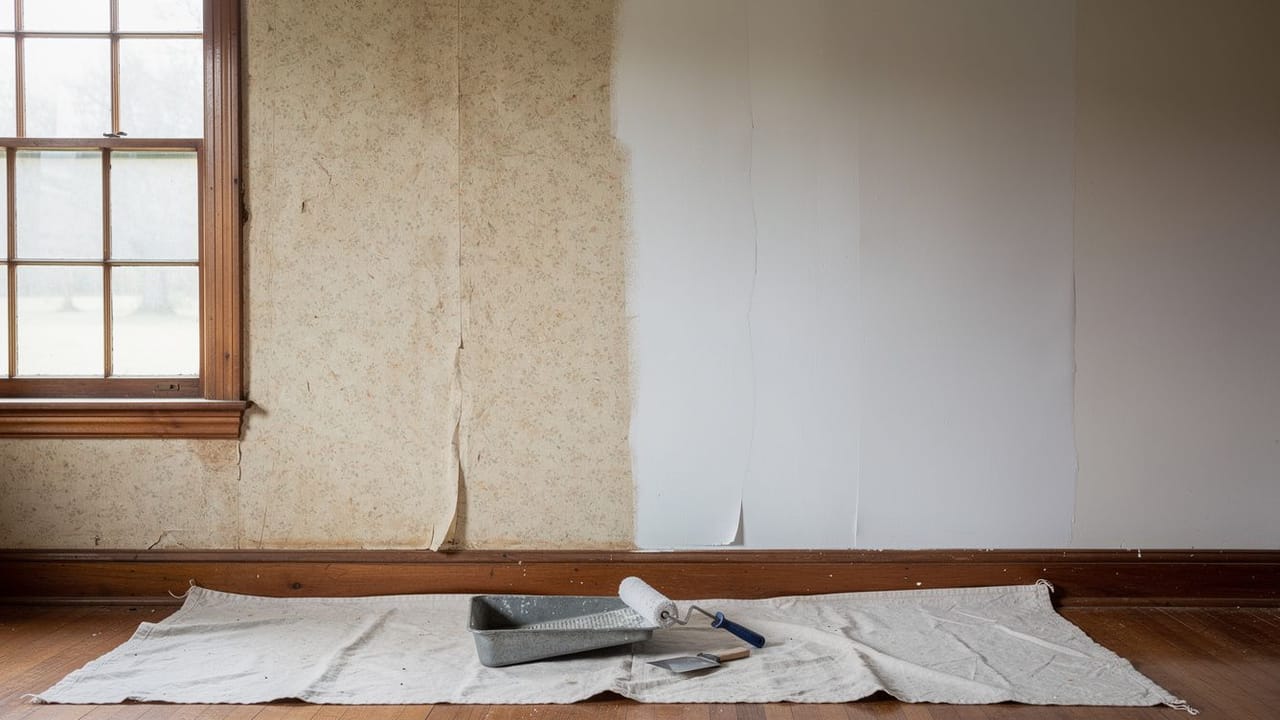
When the paper cannot reasonably come off. That is how the ShieldZ sheet frames it, reserving its primer for “non-removable wallcovering.” For us that means paper bonded tight across the whole wall, over a surface that removal would damage. Paper hung on unprimed drywall is the classic case. Zinsser’s Gardz sealer data sheet says sealing new drywall protects it from “blistering, tearing and other damage” when the room is redecorated later, and the ShieldZ sheet warns that its own sizing may not protect drywall when the wallcovering is removed. Without that seal, a stripping job can tear into the drywall’s paper face.
It is a compromise. We decide it wall by wall, after pulling an outlet cover or a loose corner to see what the paper is stuck to.
When should wallpaper be stripped before painting?
Loose paper comes off. The ShieldZ sheet says to inspect for loose wallcovering and remove it along with the old adhesive. Past that, our own rule is to strip a wall with lifting seams or bubbles, any sign of moisture behind the paper, heavy texture or embossing, or more than one layer. We do not trust paint over any of those.
Vinyl-coated paper is a separate question. Zinsser calls existing vinyl wallcovering a hard-to-stick surface, though that line is about hanging new paper over it, and none of the sheets we checked gives a method for painting over vinyl. If vinyl has to stay, we follow the data sheet of the primer going on it. Most of the time it comes off.
- Loose paper, lifting seams or bubbles: strip
- More than one layer: strip
- Any sign of moisture behind it: strip and find the source
- Heavy texture or embossing: strip
- Vinyl coating: strip, or follow the primer maker’s sheet for vinyl
How to do it so it holds
Clean the surface and trim off any loose edge instead of gluing it back, since the ShieldZ sheet treats loose wallcovering as something to remove. Then choose the primer by what its maker rates it for. The Gardz sheet warns that water-based coatings “will re-activate old wallpaper adhesive which results in cracking and peeling,” yet the same sheet recommends Gardz, a water-based acrylic sealer, for uncoated wallpaper and says it seals in old paste. For old porous or metallic paper, the ShieldZ sheet names Zinsser’s B-I-N primer. A general oil primer is not automatically the answer either: the Cover Stain oil-based primer data sheet asks for a surface free of wallpaper.
Once the sealer is dry we skim the seams so they do not read as lines through the finish, sand, spot-prime the skim and only then paint, the same skim work we do on drywall and texture repair. The Gardz sheet lists it as compatible with joint compound. Sanding in a house built before 1978 is where lead comes in. Under the EPA’s Renovation, Repair and Painting rule, anyone paid to disturb paint in a pre-1978 home must be certified in lead-safe work practices, though the rule generally does not cover owners working on their own home unless they rent it out, run a childcare center there or flip houses. Our post on lead paint in a pre-1978 Nashville house goes further.
Can painted wallpaper be removed later?
Plan on it being permanent. In our experience painted paper is a much harder strip than bare paper, because the paint keeps the stripper from soaking through to the paste.
Tell the buyer if you sell. We are not pointing to a rule there, only to how it feels to find painted paper halfway through someone else’s renovation. If you are weighing it for a particular room, ask us to look at the wall before anything gets wet.
Sources
- Rust-Oleum (Zinsser), Technical Data SHZ-03: ShieldZ Clear Wall Size (Rev. 2022) — Remove existing wallcovering whenever possible; prime over non-removable wallcovering; remove loose wallcovering; may not protect drywall when wallcovering is removed; vinyl wallcovering as a hard-to-stick surface; B-I-N for porous or metallic paper
- Rust-Oleum (Zinsser), Technical Data GDZ-01: Gardz Problem Surface Sealer (Rev. 2023) — Sealing drywall protects it from tearing when redecorating; water-based coatings reactivate old wallpaper adhesive; water-based sealer rated for uncoated wallpaper and paste residue; compatible with joint compound
- Rust-Oleum (Zinsser), Technical Data CVS-03: Cover Stain Oil Based Primer (Rev. 2023) — Surface preparation calls for a surface free of wallpaper and adhesive
- U.S. EPA, Renovation, Repair and Painting Program — Paid work disturbing paint in pre-1978 homes requires certification; homeowner exemption and its exceptions
FAQ
Painting Over Wallpaper, and When Not To — questions
Why can I not use latex primer over wallpaper?
Water-based products can reactivate the wallpaper paste behind the paper, and Zinsser’s Gardz data sheet says that leads to cracking and peeling. It does not rule out every water-based product: the same sheet recommends Gardz, a water-based sealer, for uncoated wallpaper and paste residue. Use a sealer or primer whose maker rates it for wallpaper, and read its data sheet before the first coat.
How do I know if my walls are plaster or drywall?
We take off an outlet or switch cover and look at the cut edge of the wall. Drywall shows a chalky core with paper on both faces, while the plaster we find in older houses is harder and thicker, often with lath behind it. A knock helps too: to our ear plaster sounds solid and drywall sounds hollow between the studs. The age of the house is a hint, not proof, because many older rooms have been redone in drywall.
Will painted wallpaper look obviously like wallpaper?
It can, mostly at the seams, which sit slightly raised and catch light coming across the wall. We skim them flat and usually suggest a flat or matte finish, which in our experience shows less of what is underneath. Done that way, most people walking into the room would not guess.
Can you paint over wallpaper glue?
Not with just any paint, because water-based coatings can reactivate old wallpaper adhesive and lead to cracking and peeling. Zinsser’s Gardz sheet rates that water-based sealer for paste residue and says it seals the paste in, while Zinsser’s Cover Stain oil primer asks for a surface free of adhesive. Use a product rated for it.